Choosing the right AI companion plush for global buyers takes more than comparing soft fabric and clever features. A toy may look inviting on a product page, yet feel awkward when its voice response lags or its app supports only one language. Small details matter. Think stitched seams, washable covers, clear setup instructions, and dependable customer support. Buyers should also check battery information, privacy settings, and safety documentation for each destination market.
A useful perspective comes from Sherry Turkle, an MIT scholar of technology and human relationships. She writes, “Technology proposes itself as the architect of our intimacies.” Her observation was not about plush toys specifically. Still, it raises a practical question: does the device support comforting interaction, or simply imitate it? A warm voice can feel reassuring. But vague data controls or confusing subscriptions can quickly weaken that feeling.
This guide examines what global buyers should assess before choosing an AI companion plush: interaction quality, age suitability, materials, language options, connectivity, privacy practices, and after-sales service. It also considers how product claims can be checked against manuals, test reports, and support policies. Those documents are less exciting than a demo. They matter more when something goes wrong. No checklist can predict every family’s experience, and a charming prototype may not reflect daily use. That uncertainty deserves attention, not a sales gloss. The best choice is not necessarily the most advanced plush; it is the one whose comfort, safeguards, and limitations are clear.
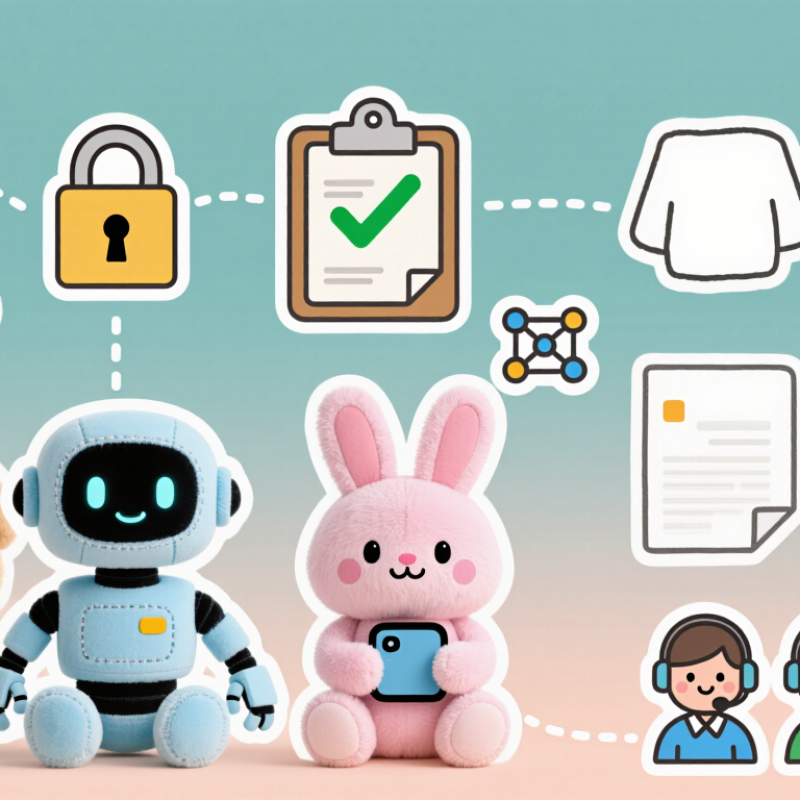
An AI companion plush combines a soft toy with sensors, a speaker, and conversational software. It may respond to touch, recognize simple phrases, or remember limited interaction details. The plush exterior matters, too: fabric texture, seam strength, and washable components affect daily use. For global buyers, check supported languages, charging requirements, and whether core functions work without an internet connection. Small details count.
Grand View Research estimated the global smart toys market at about US$13.8 billion in 2023, with projected growth through 2030. This broad category includes many products, not just AI plush toys, so it should not be treated as a plush-specific sales forecast. Still, it signals growing interest in connected play. Buyers should look beyond novelty: ask how the toy handles personal data, what parental controls are available, and whether software updates are explained clearly.
A useful companion should feel predictable, not merely clever. Test its volume in a quiet room, and notice whether replies are understandable over ordinary household noise. Battery life, response delays, and the option to mute its microphone deserve equal attention. A plush that answers every question may seem engaging, but constant interaction can become tiring. I would also verify cleaning instructions before purchase; removable electronics do not always make the remaining fabric easy to wash. This is one area where product descriptions can be vague.
For global buyers, the best AI companion plush is not the one with the most features. It is the model that fits a user’s age, language, routine, and comfort level. IDC’s Worldwide AI and Generative AI Spending Guide forecasts global AI spending will reach 632 billion dollars by 2028. That growth may improve conversational toys, but bigger investment does not guarantee better care.
Match the model to the user. Young children need limited answers, clear parental controls, and no open-ended web access. Older users may value slower speech, large controls, and reliable reminders. Multilingual families should test pronunciation, switching speed, and cultural understanding before purchase. Check microphone sensitivity in a noisy room. Test it beside a television. Small failures matter.
Privacy deserves equal attention. The UNICEF Policy Guidance on AI for Children stresses safety, privacy, transparency, and child-centred design. Buyers should inspect data retention, deletion options, account permissions, and offline functions. A useful plush should explain what it records. In practice, product claims can sound clearer than their settings.
Do not trust the demo alone. Ask for independent testing, update policies, repair information, and safety documentation. A soft shell can hide hard maintenance problems. Battery life may shrink after heavy use. Translation may still feel awkward. That is acceptable only when the seller admits limits and offers practical controls. Global buyers need comfort, not exaggerated intelligence.
This comparison uses a five-point evaluation rubric to show how different AI companion plush formats may fit common user needs. Higher scores indicate stronger suitability for the selected user group, while privacy, age suitability, accessibility, durability, and offline functionality remain important buying factors.
Score scale: 1 = limited suitability, 5 = strong suitability. The scores are model-category evaluations rather than company or brand performance data.
For 2026, buyers should compare connectivity before appearance. Bluetooth SIG’s 2024 Market Update forecasts 5.4 billion annual Bluetooth device shipments by 2028. That scale supports faster pairing and broader accessory compatibility. Still, Bluetooth alone does not guarantee a reliable companion. Test wake-word accuracy, connection recovery, and offline responses in a quiet room. Also check whether updates require a phone, Wi-Fi, or both. A small detail matters.
Customization should feel useful, not decorative. Look for adjustable voice speed, language options, response boundaries, and replaceable sound modules. A practical product should remember preferred phrases without storing unnecessary recordings. Deloitte’s 2024 Connected Consumer Survey identifies privacy and security as continuing concerns for connected-device users. Therefore, buyers should inspect retention settings, deletion controls, and clear consent notices. Local processing can reduce exposure, but it may limit conversational quality. That trade-off deserves honest testing.
The weak point is personalization. Too many preset emotions can feel repetitive after one week. A better design offers gradual learning, transparent controls, and a simple reset button. Custom shells or accessories add value only when they remain washable and durable. The AI may still mishear accents. Independent testing should include multilingual speech, weak networks, charging interruptions, and noisy rooms. These checks reveal more than a polished demonstration. Industry forecasts often cover broad connected-device markets, not plush companions specifically, so buyers should treat growth figures as context, not proof of product quality.
2026 Best AI Companion Plush for Global Buyers?
Safety, Privacy, and Compliance Across Global Markets
An AI companion plush should feel soft, but its technology needs serious scrutiny. Buyers should check battery protection, heat control, washable materials, and secure charging design. A hidden microphone can collect sensitive conversations, especially in bedrooms or family rooms. Clear consent must be available before recording or processing any voice data. It should also be easy to disable listening.
Privacy standards differ across markets. Sellers should explain where data is stored, how long it remains there, and whether it crosses borders. Strong encryption helps, but it does not solve every problem. Buyers should look for data deletion tools, child-friendly notices, parental controls, and limited data collection. Compliance may involve privacy, consumer protection, radio equipment, and toy safety rules. Requirements can change by country. That part is often underestimated.
Tips: Choose products with a physical microphone switch, visible status indicators, and offline play options. Read the privacy policy before connecting the plush to Wi-Fi. Check whether account creation is necessary. Avoid products that request unrelated permissions. Keep firmware updated, but question updates that expand data collection. Ask the seller for testing records, age guidance, and regional compliance evidence. No product is perfectly risk-free. A careful review still matters.
A buyer’s due-diligence guide, not a product ranking. Requirements depend on the product’s intended age group, features, data flows, and destination market. Verify current local rules and obtain qualified legal and product-safety advice before sale.
| Buyer dimension | What to verify | Why it matters | Relevant market reference |
|---|---|---|---|
| Age grading and intended use | Check the stated age range, warnings, small parts, cords, battery access, and whether the product is designed or marketed for children. Confirm that the age label matches the product’s actual design and foreseeable use. | Age grading affects toy-safety testing, warnings, and children’s privacy obligations. A “not for children” label alone may not settle how regulators assess a product’s intended audience. | United States: CPSC toy rules and applicable ASTM F963 requirements. European Union: toy-safety rules and relevant harmonised standards. Requirements vary by product and market. |
| Physical and electrical safety | Request applicable test reports for mechanical, flammability, chemical, battery, charging, and electrical risks. Check that reports cover the exact model, materials, accessories, and production version being purchased. | A test report for a similar model or an individual component may not establish that the complete plush is safe or compliant. | United States: CPSC requirements may apply. European Union: applicable toy-safety and other product legislation may apply. Confirm relevant standards with a qualified laboratory or compliance professional. |
| Microphone, camera, and sensors | Determine which sensors are present, when they activate, whether recording is continuous or user-triggered, and how activation is signalled. Prefer clear, accessible controls to disable listening or other sensing. | Always-on or unclear sensing can create privacy risks, particularly in homes and around children or bystanders. | Privacy duties depend on the collection and use of personal data and on local laws. In the United States, COPPA may apply to covered online services collecting personal information from children under 13. |
| Children’s privacy and parental controls | Check the age-screening approach, parental consent process where required, parent access and deletion tools, and controls over child accounts and data. Ask whether data is used for advertising or profiling. | Child-directed services and services with actual knowledge that they collect personal information from children can have additional obligations. Consent and parental-control expectations differ by jurisdiction. | United States: COPPA and its amended rule. United Kingdom: the Children’s Code may be relevant to online services likely to be accessed by children. European Union: GDPR rules for children and parental consent vary in part by Member State. |
| Voice recordings and transcripts | Ask whether raw audio is stored, whether transcripts are retained, how long each is kept, who can access them, and whether they are used to train or improve models. Confirm that deletion requests cover backups and service providers where applicable. | Voice data may reveal sensitive information and may include the voices of people who did not set up the toy. | GDPR and other privacy laws may apply when personal data is processed. Whether voice data is biometric or otherwise specially regulated depends on how it is processed and the relevant law. |
| Cloud services and international transfers | Request a data-flow map listing hosting regions, subprocessors, transfer locations, and safeguards. Check whether essential functions work without a cloud account or internet connection. | Cross-border access and transfers can trigger additional legal, contractual, and security requirements. Cloud dependence can also affect availability and product support. | For EU/EEA personal data, GDPR transfer rules may apply to transfers outside the region. Other jurisdictions have their own transfer and localisation rules; assess each sales market separately. |
| Security and software support | Look for a documented update policy, vulnerability-reporting contact, secure account recovery, encryption in transit, access controls, and a stated end-of-support date. Ask how security issues are communicated to buyers. | Connected products can remain exposed if vulnerabilities are not fixed or accounts and data are poorly protected. | Applicable cybersecurity and consumer-product rules vary by market. In the EU, the Cyber Resilience Act has phased application dates; confirm which obligations apply to the product and when. |
| AI behaviour and child-appropriate output | Test age-appropriate responses, harmful-content handling, hallucinations, escalation guidance, and whether the system clearly distinguishes generated responses from verified information. Check for parental settings and a way to report problems. | Conversational systems can produce incorrect or unsuitable responses. A disclaimer does not replace testing, monitoring, or appropriate safeguards. | EU AI Act obligations are phased, with different dates and duties for different provisions and systems. Determine whether the specific AI use falls within the Act and which requirements apply. |
| Transparency and user controls | Review the privacy notice and setup flow for clear explanations of what the toy records, why it is processed, how long it is kept, and how users can access, correct, or delete data. Check that controls are easy to find. | People need understandable information and usable controls, not only a lengthy legal notice. | Transparency and individual-rights requirements differ by jurisdiction. GDPR, for example, includes information duties and rights for data subjects where applicable. |
| Subscriptions and product lifecycle | Confirm whether core functions require a subscription, what happens when service ends, how long spare parts and updates are available, and whether the toy remains usable after account closure. | Ongoing fees, discontinued cloud services, or unavailable updates can change the product’s real cost and usefulness over time. | Consumer-protection, contract, and digital-service rules differ among markets. Review local disclosures, renewal terms, cancellation rights, and support commitments. |
| Importer and market documentation | Request the correct declaration of conformity or other required documents, traceability details, labelling, instructions in required languages, and a named responsible economic operator where applicable. | Documentation and local responsibility requirements can determine whether a product may be placed on a particular market and how safety issues are handled. | Requirements vary by destination. For EU sales, identify the applicable product legislation and responsible economic operator; do not assume one certificate covers every market. |
| Evidence to request before purchase | Ask for model-specific safety reports, a privacy and data-flow summary, security-support dates, subprocessor information, deletion procedures, age-grading rationale, and market-specific compliance documents. | Written, product-specific evidence makes it easier to compare suppliers and identify gaps before importing or listing the product. | Use current official guidance for each destination. Useful starting points include the U.S. FTC COPPA Rule, the European Commission GDPR information, and the European Commission AI Act overview. |
Compliance status cannot be inferred from a feature list or a supplier’s general claim. Check the current law, applicable standards, and product-specific evidence for every intended sales market.
For global buyers, the listed price is only part of the cost. Compare the plush unit, customization, packaging, and shipping separately. A low quote can hide setup fees or costly replacement parts. Ask for a written quote with currency, minimum order quantity, sample charges, and delivery terms. Small details matter. Request a sample and check stitching, fabric feel, speaker clarity, and how the controls respond. A soft exterior does not guarantee durable electronics.
Sourcing needs clear answers, not just attractive product photos. Ask where assembly takes place, how production quality is checked, and whether spare components are available. Confirm that product instructions and support materials can be provided in your target market’s language. Then examine after-sales terms: response times, repair options, warranty coverage, and who pays return shipping. Get these details in writing before ordering. Support can vary by destination. Also ask how voice recordings or account data are handled, and whether users can delete them. This question is easy to overlook. One limitation: supplier promises are difficult to compare without consistent test criteria. Keep a simple checklist, record sample results, and leave room in the budget for delays or defects.
Check battery protection, heat control, secure charging, and washable materials. The exterior may feel soft. The electronics still need testing. Look for age guidance and clear safety records.
Choose a product with a physical microphone switch and visible listening indicators. Offline play is useful when recording is unnecessary. Buyers should know exactly when voice data is collected. I would not trust a hidden microphone without clear controls.
It should state where data is stored and how long it remains there. It should also explain cross-border transfers, encryption, and deletion tools. Check whether account creation is required. Avoid unrelated permission requests.
Look for child-friendly notices, parental controls, and limited data collection. Families may use the plush in bedrooms or shared rooms. The listening feature should be easy to disable. Small privacy details can matter later.
Ask for testing records, age guidance, and regional compliance documents. Requirements may cover privacy, consumer protection, radio equipment, and toy safety. Rules differ between countries. That difference is easy to underestimate.
Compare the plush, customization, packaging, shipping, and replacement parts separately. Request a written quote with currency, minimum order quantity, sample charges, and delivery terms. A low quote may hide setup fees. Budget for delays and defects.
Check stitching, fabric feel, speaker clarity, charging behavior, and control response. Test the sample with a simple checklist. Write down the results. A pleasant appearance proves very little.
Ask where assembly occurs and how production quality is checked. Confirm spare component availability and support materials in the target language. Get response times, warranty coverage, repair options, and return-shipping responsibility in writing. Promises are difficult to compare without consistent tests.
This guide explores how to choose the best AI companion plush for global buyers in 2026. It explains the essential features of these interactive toys, including voice interaction, emotional responses, learning functions, tactile design, battery performance, and app connectivity. It also offers a practical framework for matching different models with children, families, collectors, and users seeking companionship, while considering ease of use, accessibility, customization, and long-term engagement.
The article compares expected 2026 developments in connectivity, personalization, language support, and smart-device integration. It also highlights the importance of age-appropriate design, data protection, transparent privacy settings, responsible artificial intelligence, and compliance with applicable regional requirements. Finally, it examines total ownership costs, sourcing reliability, warranty coverage, software updates, replacement options, customer service, and after-sales support, helping international buyers make a balanced decision based on quality, safety, value, and dependable service.