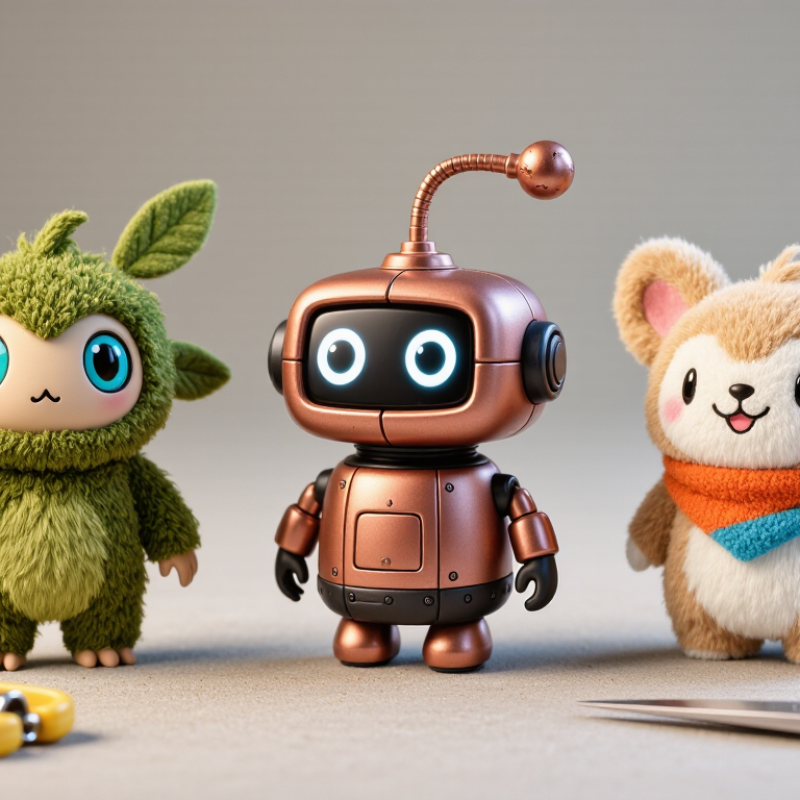
In 2026, designing a memorable toy character means giving it more than a polished image. It needs a clear shape, a readable personality, and details that still work when translated into a physical object. AI toy character design can help explore ideas quickly, from a round-eyed forest guide to a tiny robot with a scratched, copper-colored antenna. But generated concepts are starting points, not finished designs. A useful process checks whether children can recognize the character at a glance, whether its features suit plush, plastic, or another material, and whether the proposed details can be made consistently.
Begin with a simple character brief: who it is, what it wants, and what makes it distinct. Then use AI sketches to compare silhouettes, colors, expressions, and accessories rather than accepting the first attractive result. A bright scarf may look charming on screen but disappear against a toy’s body fabric. Small tests matter. Create a basic prototype, inspect its seams and proportions, and invite appropriate users to describe what they notice. Their answers may surprise you.
Keep a human designer involved throughout. Review age suitability, durability, material choices, and relevant product-safety guidance before production; a convincing render cannot verify these things. It is also worth questioning whether every suggested feature adds meaning. Some ideas will feel generic. Some will simply fail. That is useful feedback, not a reason to hide the rough edges. The strongest character often emerges through careful revision, practical testing, and a few honest decisions about what to leave out.
Define the Toy’s Purpose, Audience, and Core Character Concept
Before drawing an AI toy character, decide what the toy should help a child do. It might encourage storytelling, answer simple questions, or make quiet play feel more interactive. Pick one main purpose. A toy that tries to teach, entertain, comfort, and compete for attention may feel confusing rather than useful.
Define the intended audience through real play situations, not age labels alone. Consider whether children will use the toy independently, with a caregiver, or alongside other toys. Then shape a character that fits those moments: a curious garden explorer might ask children to notice leaf shapes, while a shy moon creature could invite gentle storytelling. Keep its voice, abilities, and limits consistent. Small details matter. A tiny pause before an answer can make a character feel thoughtful; a dramatic voice may overwhelm a quiet room. Test the concept with caregivers and children, and watch where they lose interest or misunderstand the character. I would not treat one test as proof. Play habits vary, and an appealing sketch can still become tiring after repeated use.
Develop a Distinctive Visual Identity and Character Profile
In 2026, an AI toy character needs more than a polished image. It needs a visual identity that stays recognizable across sketches, screens, and physical prototypes. Start with one clear silhouette: perhaps a broad raincoat, short boots, and a lantern-shaped head. Keep the palette tight, such as moss green, warm cream, and one coral accent. Small details should support the same idea, not compete with it. A crooked seam can feel more memorable than five decorative badges.
Write a character profile before generating variations. Define its story age, daily purpose, temperament, strongest desire, and one believable limitation. For example, a careful night gardener might remember every seed but confuse directions. That flaw gives scenes room to grow. Note how the character moves, speaks, and reacts when surprised; “pauses, then asks twice” is more useful than “cute and friendly.” Use these traits as prompts, then compare results against a reference sheet: silhouette, eye spacing, colors, and signature object. AI can drift. Test it. Check each version at thumbnail size and beside the intended toy materials.
Keep a dated record of prompt changes and rejected designs. It helps distinguish real improvements from lucky variations. Ask children or caregivers simple, neutral questions: What do you notice first? What might this toy do? Avoid guiding them toward your answer. Their guesses may expose a confusing face or a prop that reads differently than intended. Not every inconsistency needs fixing; some become charm. Still, choose deliberately, and make sure the profile matches the object’s scale, texture, and practical construction.
Choose AI Tools and Create Initial Character Designs
In 2026, choose an AI tool for the work you need, not its novelty. Text-to-image tools can quickly explore shapes and moods, while sketch-to-image tools help preserve a hand-drawn idea. A simple reference board can keep colors, proportions, and materials consistent. Start with a short design brief: who the toy is for, its personality, and how it might be held or played with. Then describe visible details, such as a pear-shaped body, oversized painted eyes, and soft-looking fins. Keep prompts clear. Too many adjectives often muddy the result.
Generate several concepts, not just one polished image. Compare their silhouettes at thumbnail size; a character should still read clearly on a small screen. Check whether its limbs look movable and its details seem practical to manufacture. AI images can suggest a glossy surface, but they cannot confirm how a real joint will work. That distinction matters. I would save the prompt and note what changed between versions, though I sometimes forget—and then comparisons get messy. Refine one feature at a time, such as shortening the ears or widening the feet. Keep an awkward sketch if it has a memorable shape; the cleanest image is not always the strongest toy idea.
Refine the Design for Safety, Playability, and Manufacturing
An AI-generated toy character may look charming on screen, yet tiny details change once children handle it. Translate the artwork into physical constraints: rounded edges, secure parts, and surfaces that are easy to clean. Check eyes, ears, and decorative pieces for weak joints or gaps that could pinch fingers. Use prototypes, not renders. A first successful sample is not proof; it may only reveal the obvious problems.
Playability needs equal attention. A figure should stand steadily, fit a child’s grip, and support more than one kind of play. Test joints through repeated movement, and check whether accessories stay attached during ordinary handling. Observe supervised play and note where children hesitate, pull, or lose interest. That feedback may challenge the original design. Good.
Manufacturing choices shape the character as much as its artwork. Simplify fragile projections, keep wall thickness consistent, and leave room for assembly tools. Review material choices, color variation, seams, and cleaning needs with the production team. Early samples can reveal awkward joins or parts that are harder to assemble than they looked on screen. Some detail may need to go. That can feel like a loss, but a simpler feature may be safer, sturdier, and easier to make consistently.
Test the Character and Prepare It for Production
A character that looks charming on screen may feel awkward in a child’s hands. Make a simple physical mock-up before polishing the artwork. Check whether the head feels balanced, the limbs move without catching, and the face stays readable from across a room. Small details matter. A tiny mouth can disappear under soft lighting, while oversized eyes may look unsettling at close range.
Test several prototypes with children and caregivers in short, observed play sessions. Note where attention drifts, which parts get squeezed, and whether the character invites repeated play. Ask open questions rather than steering reactions. One test may reveal that a supposedly playful tail keeps snagging on clothing. That is useful evidence, not a design failure. Still, a few sessions cannot represent every user, so record who participated and what remains uncertain.
Before production, review material samples, seams, color consistency, and moving parts with the manufacturing team. Check how the toy performs after repeated handling and cleaning, using methods suited to its intended materials. Keep a version-controlled specification with measurements, approved colors, and clear tolerances. Leave room for real-world variation; fabric texture and paint can shift between samples. The first production-ready design may still need revision. That is normal.
How to Design AI Toy Characters in 2026: Test the Character and Prepare It for Production
Before production, review small detachable character parts for age suitability. The U.S. small parts test cylinder is 1.25 inches in diameter and 2.25 inches deep. A part that fits entirely inside may be classified as a small part; toys intended for children under three are generally subject to restrictions. Check the applicable regulations and test requirements for your product.
Conclusion
Designing an AI toy character in 2026 starts with a clear purpose, a defined audience, and a simple core idea that can guide every later decision. Consider what the toy should encourage—such as imaginative storytelling, learning, or comforting play—and shape a personality that feels appropriate for its intended age group. Build a distinctive visual identity with recognizable colors, shapes, expressions, and defining traits, then record these choices in a character profile so the design remains consistent.
Use AI tools to explore early concepts, but treat their results as starting points rather than finished designs. Refine the selected character with safety, durability, ease of handling, and realistic manufacturing in mind. Check that its features suit hands-on play and that materials and construction can be produced responsibly. Finally, gather feedback from representative users and caregivers, revise the design where needed, and prepare clear specifications for production. A thoughtful AI toy character design balances originality with usability, safety, and practical production requirements.