China has become a major manufacturing base for digitally enhanced toys, but identifying the best suppliers requires more than browsing product galleries. This guide examines manufacturers developing AI generated toy designs, including interactive figures, educational robots, collectible characters, and customized plush products. It considers design capability, tooling experience, material control, prototype speed, and transparent communication.
Market signals support this focus. Circana’s Global Toy Industry Performance reports show that toy demand is increasingly shaped by innovation, licensing, collectibles, and technology-supported play. Grand View Research also identifies artificial intelligence and connected devices as important forces influencing future consumer products. McKinsey’s State of AI research found that many businesses now experiment with generative AI, although practical value still depends on data quality, human review, and production discipline. The lesson is simple.
Ideas still need engineering.
A reliable Chinese manufacturer should demonstrate how a digital concept becomes a safe, manufacturable product. Look for clear CAD workflows, resin or 3D-printed samples, child-safety testing, paint adhesion checks, and documented quality inspections. ISO 9001 systems can indicate process consistency, while testing against relevant ASTM F963, EN 71, or other destination-market requirements supports responsible sourcing. These standards do not guarantee perfection, but they create useful checkpoints.
This comparison may not identify one universal winner. Supplier strengths vary by order quantity, age range, licensing needs, and customization depth. Some factories present impressive renders but offer limited evidence of production experience. That deserves careful questioning. The strongest candidates combine creative AI-assisted development with accountable human designers, stable factories, and honest timelines. Expect practical details, not perfect claims.
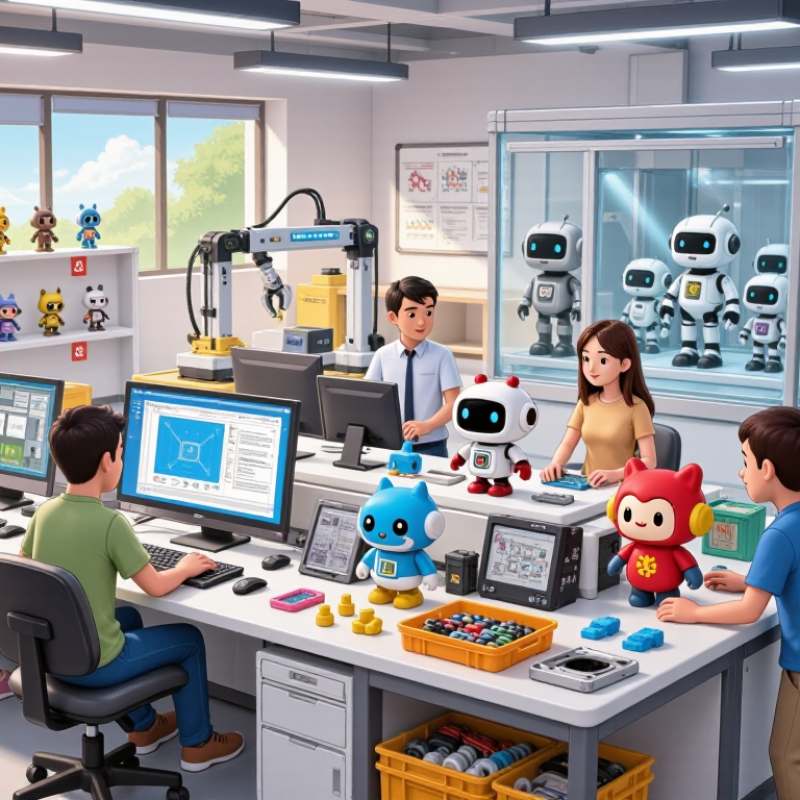
AI-generated toy designs are digital concepts created with machine-learning software. A designer enters prompts, sketches, colors, materials, and age requirements. The system may produce several shapes within minutes. One version might show a soft blue animal with rounded ears and a movable tail. Another may look attractive but impossible to manufacture.
In professional toy development, AI is an assistant, not the final decision-maker. Experienced designers check proportions, balance, grip comfort, and cleaning needs. They also review whether small parts could detach during normal play. A digital image cannot prove that a hinge will survive repeated use. It cannot replace material testing, prototype inspection, or documented safety checks. Manufacturing teams usually convert the selected concept into technical drawings. They then test samples using suitable plastics, fabric, paint, or wood.
The process still has weaknesses. AI may copy familiar visual patterns without understanding cultural meaning or child behavior. It can also suggest thin walls, sharp corners, or unstable bases. That assumption can fail. Human review remains essential. I have found that simple revisions often improve a design more than extra visual effects. A rough prototype reveals problems early: a head may tip forward, a button may feel too small, or a surface may collect dirt. Reliable manufacturers record these changes and verify each production stage against approved specifications.
AI-generated toy designs use generative AI to transform text prompts, sketches, images, and product requirements into new toy concepts, character shapes, color systems, packaging ideas, and early-stage 3D forms. The chart shows reported generative AI usage across business functions, highlighting the strong relevance of product and service development to AI-assisted toy design.
Data source: McKinsey, The State of AI in Early 2024. Percentages represent respondents reporting regular generative AI use by business function.
China’s toy factories are moving AI from concept boards into daily product development. Design teams now turn a sketch, color brief, or child-age profile into multiple visual options within minutes. Generative tools can propose shapes, textures, packaging layouts, and themed accessories before physical samples exist. That speed matters. McKinsey’s 2024 State of AI survey found that 65% of respondents regularly used generative AI in at least one business function.
China also has strong technical momentum. The World Intellectual Property Organization’s 2024 patent landscape report recorded 38,210 generative AI patent applications from China-based inventors between 2014 and 2023. Toy manufacturers are applying similar capabilities to pattern development, mold planning, and customized production. A factory may test ten digital character forms, select three, and print small prototypes before opening a full mold. This reduces early waste, but it does not remove development costs.
AI is not a safety certificate. Experienced manufacturers still check small parts, material strength, paint adhesion, and age suitability through documented testing. A generated plush character may look appealing yet hide difficult seams or unstable proportions. Human review catches those failures. The weak point remains judgment. Suppliers with traceable design records, trained engineers, and clear revision controls offer stronger reliability than studios selling attractive AI images alone. Some workflows still produce inconsistent results, especially when prompts lack cultural or manufacturing detail. That imperfection deserves attention.
Leading Chinese AI toy manufacturers combine generative design, engineering, and factory execution. Their teams can translate a child’s sketch into several concept models within hours. AI tools adjust silhouettes, colors, joints, and surface textures from simple prompts. Experienced designers still review every output for balance, age suitability, and practical assembly. A digital bear may look charming, yet its ears can create weak molding points. That detail matters on a production line.
Strong suppliers connect AI workflows with 3D sculpting, CAD, rapid prototyping, and tooling analysis. They print resin samples, test articulation, and inspect seams under direct light. Engineers check materials, paint adhesion, small-part risks, and repeated-use strength. Reliable manufacturers document revisions and preserve approved files for traceability. They also support low-volume sampling before larger production. This reduces waste, although it does not remove every design mistake. Some AI concepts remain visually impressive but commercially impractical.
A capable partner can localize designs for different markets without copying protected characters or sensitive cultural symbols. Clear communication is essential. Buyers should request sample records, test reports, factory photos, and quality-control procedures. Production experience helps teams estimate mold costs, packaging space, and realistic delivery schedules. Specific feedback improves AI results. “Make it better” is weak guidance. “Reduce the head by ten percent and soften the shoulder joint” gives engineers measurable direction. Even advanced systems need patient review, because novelty can hide ordinary manufacturing problems.
A strong AI toy design manufacturer should prove more than attractive digital images. Ask for dated concept files, prompt records, material samples, and a working prototype.
McKinsey’s 2024 State of AI report found that 65% of surveyed organizations regularly use generative AI. This shows adoption is growing, but it does not prove design quality.
Check whether engineers review AI outputs for structure, safety, durability, and production cost.
Request a clear development workflow.
Can the team turn a sketch into a 3D model, mold drawing, color sample, and small-batch prototype?
During a factory visit, inspect print layers, joint movement, paint edges, and packaging seals.
A reliable supplier should explain testing under ISO 8124, ASTM F963, or applicable regional requirements.
The European Commission’s 2023 Safety Gate report recorded 3,412 product alerts, with toys among the frequently reported categories. Compliance cannot be treated as decoration.
Examine data protection and revision control. Who owns the generated files? How are children’s images, voice inputs, and design references stored?
The U.S. CPSC reported an estimated 232,900 toy-related emergency department injuries among children under 15 in 2023.
Therefore, request test reports for small parts, sharp edges, magnets, coatings, and mechanical stress.
I would also order a pilot batch before signing a large contract.
AI can shorten ideation, but my evaluation may still miss hidden production weaknesses. That is why independent testing remains necessary.
China’s leading AI-generated toy manufacturers begin with a controlled design brief. Designers define age range, dimensions, materials, play functions, and safety limits before prompting an AI system. The first output is only a visual direction. It is not a production-ready product.
Engineers convert the concept into a 3D model, then print a rough prototype in resin or plastic. They check grip comfort, balance, moving joints, paint areas, and small-part risks. The 2024 Circana Global Toy Market Report recorded a 1% decline in global toy sales, increasing pressure to reduce costly revisions. A practical factory usually creates several prototypes. Some fail visibly. That failure saves money later.
After approval, manufacturers prepare steel tooling, color standards, assembly instructions, and inspection plans. Material samples are tested for durability, odor, sharp edges, and mechanical safety. The China Toy and Juvenile Products Association identifies quality control and product innovation as continuing priorities for the sector. Independent testing should verify applicable requirements, including international toy-safety standards. Production then moves through molding, trimming, painting, assembly, and batch inspection. AI can accelerate concept work, but it cannot judge every hand feel or factory tolerance. That remains a human responsibility.
AI can turn a child’s sketch into several design concepts within hours. It can adjust shapes, colors, joints, and surface textures. Human designers must still review balance, age suitability, and assembly practicality. Fast does not mean finished.
No. The digital image is only a visual direction. Engineers must build a 3D model and create physical prototypes. A charming bear may have weak ear joints or difficult molding areas. Appearance can hide production problems.
Factories may print resin or plastic samples. Teams check grip comfort, balance, moving joints, paint zones, and seams. They inspect surfaces under direct light. Some prototypes fail visibly. That can prevent expensive tooling mistakes.
Strong teams connect AI workflows with 3D sculpting, CAD, rapid prototyping, and tooling analysis. These tools help prepare accurate models and practical molds. Engineers still make the final decisions. Software cannot feel a rough edge.
They examine materials, odor, sharp edges, paint adhesion, small parts, and repeated-use strength. Testing should verify applicable toy-safety requirements in each target market. Safety checks need records. One overlooked joint can become a serious concern.
Multiple prototypes reveal problems before steel tooling begins. They can expose poor balance, uncomfortable grips, weak joints, or oversized packaging. Low-volume sampling reduces waste. It does not remove every mistake.
Buyers should request sample records, test reports, factory photos, revision histories, and quality-control procedures. They should also ask about mold costs, packaging space, and delivery schedules. Clear documents make problems easier to trace.
Specific feedback produces better revisions. “Make it better” gives engineers little direction. “Reduce the head by ten percent and soften the shoulder joint” is measurable. Even then, patient review remains necessary. Novelty can distract from ordinary manufacturing limits.
AI generated toy designs are reshaping how concepts become market-ready products in China. By combining generative algorithms, digital modeling, trend analysis, and human creativity, manufacturers can quickly explore character shapes, play functions, colors, materials, and packaging concepts. This approach supports faster development, more design variations, and better adaptation to different age groups and market preferences while maintaining attention to safety, durability, and practical production requirements.
China’s leading AI toy manufacturers typically offer integrated capabilities covering concept creation, 3D visualization, prototype development, material selection, tooling, testing, and mass production. When evaluating a supplier, buyers should consider design expertise, AI and engineering resources, communication, quality-control systems, production capacity, customization flexibility, and compliance with applicable toy safety standards. The process generally moves from an AI-assisted concept to refined digital drawings, functional prototypes, testing, tooling, pilot production, and final inspection, ensuring that creative ideas can be transformed into reliable finished toys.