0%

Choosing where to buy the best AI plush toys from China requires more than comparing prices. A soft animal with glowing cheeks may look charming online. Its real quality appears during testing. Does the voice recognition work in a noisy bedroom? Can a child wash the cover safely? Does the battery remain stable after repeated charging? These details separate a reliable product from an attractive sample.

China offers extensive manufacturing experience in Shenzhen, Dongguan, Ningbo, and other production centers. However, location alone does not guarantee quality. Buyers should examine factory audits, prototype records, material specifications, software support, minimum order quantities, and export documentation. Independent testing is also important for batteries, small components, wireless functions, and child-safety requirements. Privacy deserves equal attention. AI plush toys may collect voice data, so suppliers should explain storage, access, deletion, and parental-control procedures clearly.

Richard Gottlieb, founder of Global Toy Experts, has often described the sector this way: “The toy business is a relationship business.” His observation matters here. A dependable supplier answers difficult questions before receiving a purchase order. It shares realistic production timelines. It accepts reasonable revisions after sample testing. That sounds simple. It is not always common.

This guide compares sourcing options through practical experience, product evidence, and supplier transparency. I would not pretend that one factory suits every buyer. A low-cost plush toy may fit a promotional order but fail during long-term use. An advanced model may offer better interaction, yet require stronger technical support. Careful judgment remains essential.
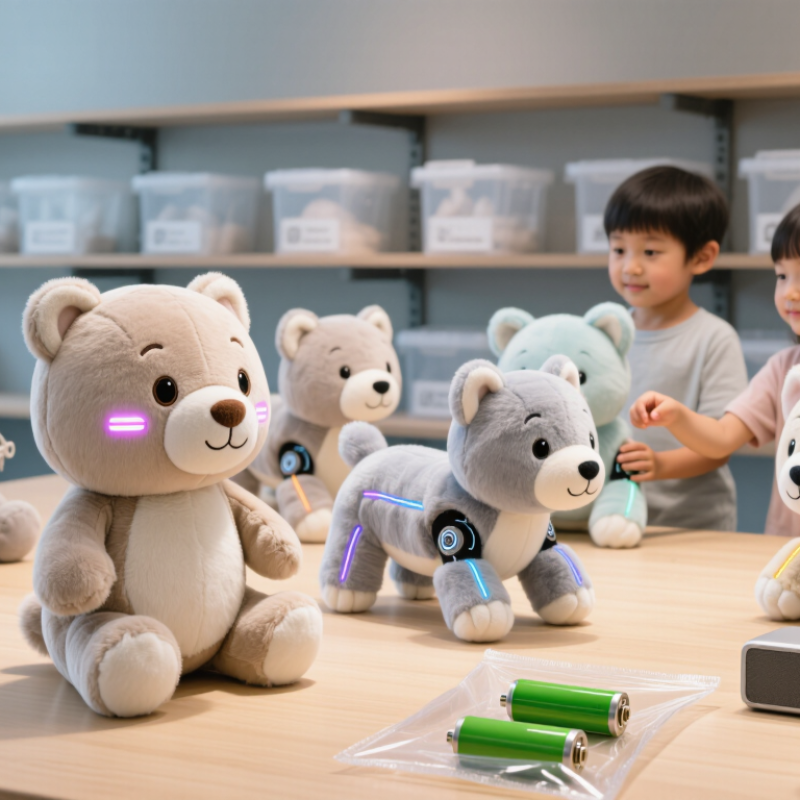
Where to Buy the Best AI Plush Toys from China?

What Defines a High-Quality AI Plush Toy?

A high-quality AI plush toy begins with safe, durable construction, not a clever voice alone. Check the fabric closely: it should feel soft, shed little, and keep its shape after gentle handling. Seams need even stitching, especially around ears, feet, and battery compartments. A loose thread may look minor. It can become a failure point. When sourcing from China, ask suppliers for material specifications, production photos, age guidance, and inspection records. Reliable sellers should explain their testing process clearly.

The interactive system also deserves practical testing. Voices should sound clear in a quiet room, while responses remain suitable for a child’s age. Test buttons, sensors, charging behavior, and automatic shutoff before placing a large order. Confirm secure data practices and readable instructions. Suppliers should provide samples, traceable production details, and after-sales support. Do not trust polished videos alone. A sample may reveal stiff fabric, weak volume control, or delayed responses that specifications hide.

Tips: Request one sample from each shortlisted factory. Inspect seams, sound quality, odor, packaging, and battery performance. Record defects with photos and dates. A checklist helps, but it is not perfect. Repeat testing after transport, because vibration and temperature can expose weaknesses. Ask whether replacement parts and technical support are available. That answer often reveals a supplier’s real reliability.

Where to Buy the Best AI Plush Toys from China?

What Defines a High-Quality AI Plush Toy?

This 100-point buyer evaluation framework prioritizes product safety and compliance, followed by reliable AI interaction, durable materials, battery safety, and supplier traceability. Buyers should request test reports, sample units, firmware demonstrations, and production-quality evidence before placing an order.

Where to Find Reliable AI Plush Toy Suppliers in China?

Reliable AI plush toy suppliers in China are usually found through verified manufacturing directories, trade fairs, and direct factory audits. Avoid choosing from photos alone. Ask for production videos, sample records, and evidence of quality control. A supplier should explain its stuffing process, voice module, battery protection, and software update method clearly.

7%
decline in worldwide toy sales during 2023
USD 10.4 billion
estimated global plush toy market in 2023

The 2024 Circana Global Toy Market Report recorded a 7% decline in worldwide toy sales during 2023. This makes cost pressure real, but cheaper production can hide weak testing. Grand View Research estimated the global plush toy market at about USD 10.4 billion in 2023, with continued growth expected through 2030. These figures suggest opportunity, but not every AI plush supplier has equal technical experience. Check whether the factory manages both textile production and electronic assembly. Request test reports covering flammability, small parts, battery safety, and chemical limits. Requirements may include EN 71, ASTM F963, or China’s GB 6675, depending on the destination market.

Tips: Compare at least three suppliers. Order paid samples before signing. Inspect stitching, sound volume, charging heat, and wash resistance. Confirm who owns the design files and firmware. Keep these terms in writing. I still treat polished samples cautiously; a perfect prototype may not represent mass production. Ask for a pilot order and independent inspection before scaling. Supplier reliability is proven by repeated batches, not confident promises.

How to Evaluate Chinese AI Plush Toy Manufacturers

Where to Buy the Best AI Plush Toys from China?

Choosing an AI plush toy manufacturer requires more than checking photos and factory prices. A practical audit starts with the sample. Test voice recognition in a noisy room, measure response time, and inspect stitching around the battery compartment. Ask for production records, material specifications, and independent laboratory reports. For target markets, verify relevant requirements such as EN 71, ASTM F963, CPSIA, and child-data privacy rules.

The wider market also deserves careful interpretation. IDC’s Worldwide AI and Generative AI Spending Guide forecasts global AI spending above 632 billion US dollars by 2028. This signals strong technology investment, but it does not prove demand for every AI plush toy. Grand View Research has also identified smart toys as a growing product category. Still, market forecasts can feel too optimistic. Check real reorder history, not only projected sales. A reliable manufacturer should explain its failure rate, warranty process, software update method, and replacement-part availability.

Tips: Request three samples from different production batches. Compare speech clarity, fabric weight, seam strength, and charging behavior. Ask whether microphones can be disabled physically. Confirm where voice data is stored and how long it remains there. Visit the factory, or hire an independent auditor. A low quote may hide weak testing, unstable components, or expensive after-sales claims. Small details matter.

Where to Buy the Best AI Plush Toys from China? - How to Evaluate Chinese AI Plush Toy Manufacturers
Evaluation Dimension Suggested Weight Objective Benchmark Evidence to Request Recommended Decision Rule
Toy Safety Compliance 20% For the United States, the product should be assessed against ASTM F963 and applicable Consumer Product Safety Improvement Act requirements. For the European Union, EN 71 and applicable REACH restrictions should be reviewed. Recent test reports from an appropriately accredited laboratory, product specification sheet, bill of materials, and testing scope that matches the final product. Pass only when the reports identify the same materials, construction, electronics, and intended age group as the production sample.
Electrical and Battery Safety 12% Electronic toys may require evaluation against applicable electrical-toy requirements, such as IEC 62115. Lithium batteries generally require transport testing under UN 38.3 when shipped internationally. Battery specification, protection-circuit details, charger information, electrical safety reports, and UN 38.3 documentation where lithium batteries are used. Reject or hold approval if the battery, charger, or electronic module differs from the tested configuration.
AI Functionality and Response Quality 14% Voice recognition, response generation, wake-word detection, language support, offline behavior, and failure handling should be tested using a documented test set. Demonstration unit, test script, supported-language list, response examples, latency measurements, and error-handling procedure. Use a written acceptance test; approve only when critical commands and safety-related responses meet the agreed accuracy and latency targets.
Child Privacy and Data Protection 14% Products that collect or process children’s voice or personal data must be assessed against applicable privacy laws, including COPPA in the United States and GDPR requirements in relevant European markets. Data-flow diagram, privacy policy, data-retention period, deletion process, parental-consent method, hosting location, and list of third-party service providers. Do not approve until data collection is minimized, retention is documented, and required parental controls are operational.
Material and Soft-Toy Quality 10% Fabric, filling, embroidery, seams, eyes, accessories, and adhesives should remain secure during intended use and foreseeable handling. Material composition, colorfastness results, seam-strength checks, pull-test records, wash-care instructions, and a production-representative sample. Approve only after inspection of a sample made with the same fabric, filling, thread, accessories, and assembly process used in production.
Quality-Control System 10% Incoming-material inspection, in-process checks, final inspection, defect classification, and corrective-action procedures should be documented. ISO 2859-1 may be used as a sampling reference. Quality manual, inspection checklist, sample size, defect definitions, corrective-action reports, and independent pre-shipment inspection results. Set contractual AQL limits and critical-defect rules before production; never rely on visual inspection alone for safety-critical features.
Traceability and Change Control 7% Each production batch should be traceable to key raw materials, electronic components, assembly records, inspection results, and shipment documents. Lot-code format, bill-of-materials revision history, supplier records, batch records, retention policy, and product-change notification procedure. Require written approval for changes to fabric, stuffing, battery, voice module, firmware, supplier, or manufacturing location.
Prototype-to-Production Capability 5% The supplier should demonstrate that the approved prototype can be reproduced consistently at production scale without changing safety-critical or functional specifications. Engineering sample, pilot-run report, golden sample, production process flow, tooling list, and first-article inspection record. Approve mass production only after a pilot batch matches the approved golden sample and passes the agreed inspection plan.
Packaging and Shipping Readiness 4% Packaging should protect the plush toy and electronics from compression, moisture, electrostatic risk, and battery-related shipping hazards. Packaging drawings, carton specifications, drop-test results, moisture protection plan, shipping marks, and battery transport documents where applicable. Conduct a packaging trial and verify the final packed product before booking international freight.
Commercial Transparency 4% Pricing should clearly separate product cost, tooling, packaging, testing, software services, minimum order quantity, payment terms, and shipping assumptions. Itemized quotation, tooling ownership terms, production lead-time schedule, warranty terms, replacement policy, and payment milestones. Prefer quotations that identify one-time and recurring costs separately and define remedies for defects or nonconforming goods.
Recommended scoring method: Rate each dimension from 0 to 5, multiply the rating by the suggested weight, and require a total score of at least 80/100 with no failed safety, battery, privacy, or traceability item. Certification and test requirements should always be confirmed for the destination market, product age group, materials, electronics, and final production configuration.

Which Safety Certifications Should Buyers Check?

When sourcing AI plush toys from China, buyers should verify safety documents before discussing price or packaging. Ask for reports tied to the exact toy model, materials, battery, and voice module. A generic certificate may describe another product. Check the laboratory name, test date, factory details, and report number. Contact the laboratory independently when possible.

For the United States, review compliance with ASTM F963 and applicable CPSIA requirements. For the European market, look for EN 71 testing, REACH information, and a valid CE Declaration of Conformity. CE is usually a declaration, not a laboratory certificate. Toys using Bluetooth or Wi-Fi may need additional radio compliance, such as RED requirements in Europe or FCC requirements in the United States. Electrical parts also deserve separate testing.

China’s GB 6675 toy safety requirements can support factory quality checks, but they may not replace destination-market testing. Ask for tests covering small parts, flammability, heavy metals, stitching strength, battery heating, and accessible wiring. Test the sample yourself. Pull the ears and seams. Charge the toy overnight under supervision. Listen for unexpected sounds. Safety is not only paperwork.

I once trusted a polished PDF too quickly. That was a weak habit. Documents can be valid yet incomplete for the final version. Recheck after any fabric, battery, software, or supplier change. Keep signed samples and inspection photos with every purchase record.

How to Compare Samples, Prices, and Shipping Options?

When comparing AI plush toys from China, request identical samples from at least three factories. Test voice recognition, battery life, stitching, washable surfaces, and response delay. A toy that feels soft may still hide weak seams. Ask for a written component list, sample video, carton dimensions, and production timeline. My own mistake was judging quality from photos. The first sample looked charming, but its speaker sounded harsh in a quiet room.

Compare prices by separating the toy, electronics, packaging, tooling, inspection, and shipping. McKinsey’s 2024 State of AI survey found that 65% of organizations regularly use generative AI, showing strong demand for interactive products. However, demand does not guarantee reliable hardware. Request pricing at several quantities, such as 100, 500, and 1,000 units. Check whether the quote includes export packing and replacement parts. Small costs multiply quickly.

Tips: Use one product specification for every supplier. Record test results in a simple table. Choose shipping after confirming carton weight and volume. UNCTAD’s Review of Maritime Transport 2024 reports that over 80% of global merchandise trade by volume moves by sea, so ocean freight can reduce unit costs for larger orders. Air shipping is faster, but often expensive for bulky plush toys. Ask for both options, plus insurance and estimated customs handling. Delivery estimates can be optimistic. Build extra time into your launch plan.

FAQS

How should I evaluate an AI plush toy manufacturer?

Start with physical samples, not factory photos. Test voice recognition in a noisy room. Measure response time with a stopwatch. Inspect seams around the battery compartment. Ask for production records and material specifications. Request independent laboratory reports. A factory visit helps. An independent audit may reveal hidden weaknesses.

How many samples should I request?

Request three samples from different production batches. Compare speech clarity, fabric weight, seam strength, and charging behavior. Test each sample under the same conditions. Record results in a simple table. One sample can look perfect by accident. That happened to me.

What product functions need practical testing?

Test voice recognition, battery life, response delay, and speaker quality. Try the toy in a quiet room and a busy room. Check whether the microphone can be disabled physically. Inspect washable surfaces and charging ports. A soft toy may hide weak seams. Do not trust appearance alone.

What safety and privacy information should I request?

Ask which toy safety requirements apply to your target market. Request relevant test reports before placing a large order. Confirm where voice data is stored. Ask how long voice data remains there. Check whether parents can delete stored information. Privacy details are easy to overlook.

How should I compare prices from different factories?

Use one product specification for every supplier. Separate the toy, electronics, packaging, tooling, inspection, and shipping costs. Request prices for 100, 500, and 1,000 units. Ask whether replacement parts are included. Confirm export packing details. Small costs multiply quickly.

Why can a low quotation be risky?

A low price may hide weak testing or unstable components. It may also exclude packaging, inspection, or replacement parts. Ask about failure rates and warranty procedures. Request details about software updates. Confirm replacement-part availability. Cheap is not always economical.

How should I choose shipping?

Ask for carton dimensions, weight, insurance, and customs estimates. Compare ocean and air shipping options. Ocean freight may reduce unit costs for larger orders. Air shipping is faster but often expensive for bulky toys. Delivery estimates can be optimistic. Leave extra time.

What after-sales questions should I ask?

Ask how defective units are identified and replaced. Request written warranty terms. Confirm response times for technical problems. Check whether software updates require an internet connection. Ask how spare parts are stored and shipped. I would not assume support is included.

Conclusion

Finding the best AI plush toys from China requires more than comparing attractive designs and low prices. A high-quality product should combine soft, durable materials with reliable voice interaction, responsive sensors, stable software, and a child-friendly design. Buyers should look for suppliers with clear production capabilities, consistent quality-control procedures, transparent communication, and experience handling international orders. Visiting supplier directories, trade fairs, or verified manufacturing platforms can help identify dependable partners without relying only on online descriptions.

Before placing a large order, buyers should evaluate factory samples, customization abilities, production lead times, minimum order quantities, and after-sales support. Safety documentation is equally important, including relevant toy safety, electrical, battery, and electromagnetic compatibility certifications for the target market. Comparing sample performance, unit pricing, tooling fees, packaging, shipping methods, and import costs provides a more accurate total budget. Careful testing and supplier verification can help buyers source safe, durable, and competitively priced AI plush toys from China.

Clara

Clara

Clara is a dedicated marketing professional with a strong understanding of the company’s products, customers, and market landscape. Through her practical experience and analytical approach, she transforms complex product information into clear, valuable, and engaging content for a wide range of......